


Can Bitcoin rally if the Federal Reserve keeps rates higher for longer?
The US Federal Reserve (Fed) raising interest rates in September after a three-year gap to control alarming inflation numbers renews the fear of reduced liquidity weighing on Bitcoin (BTC), similar to the 2022 bear market.
The inflation concerns can be traced back to higher Brent Oil prices following the US-Iran war that began on February 28, which continues to disrupt shipments through the Strait of Hormuz, directly affecting global markets and investor sentiment.
To curb rising inflation, the Fed is forced to raise interest rates, which reduces market liquidity and demand at both the consumer and producer levels. As a result, investors’ risk appetite declines, weighing on stocks, crypto, and other high-risk assets.
Although the war is broadly priced in, the possibility of the Fed raising rates in the future, similar to the 2022 cycle, raises the question: Will Bitcoin renew its bear cycle?
Geopolitical concerns risk turning the clock back to March 2022
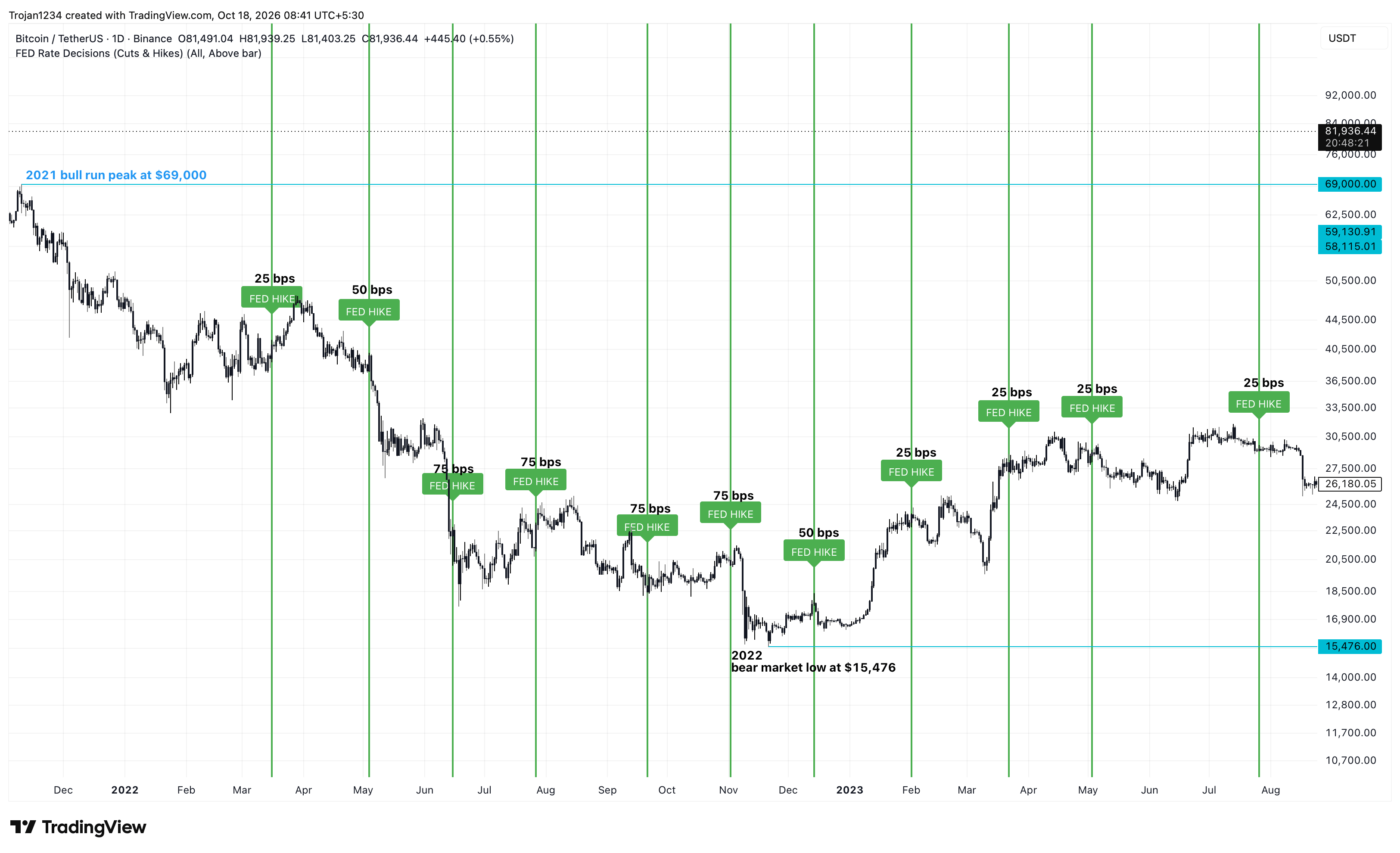
The broader market worries about a similar playout to Bitcoin’s 2022 bear market, when Brent Crude Oil surpassed $130 per barrel, prompting the Fed to raise the fed funds rate over multiple months.
Market jitters rose as the US Fed was forced to raise interest rates by a quarter point for the first time in three years on September 16. The fed funds rate was hiked to a target range of 3.75% to 4.00%. The US Consumer Price Index (CPI) rose to 3.7% YoY in September, up from 3.4% in August, while monthly inflation accelerated to 0.6%.
However, this move was followed by the Fed keeping the benchmark interest rate unchanged on October 28, with a 10-2 decision implying that further hikes lie ahead. Persistent price pressure could keep financial conditions restrictive and limit capital available for speculative assets.
The 2022-23 cycle demonstrates this complex relationship between Bitcoin and rate hikes. The BTC price fell nearly 78% from about $69,000 in November 2021 to approximately $15,476 in November 2022, while the Fed raised rates from near zero to 4.25%–4.50%.
The four consecutive 75-basis-point hikes in 2022, sandwiched between three smaller hikes, accelerated monetary tightening. Coupled with the Terra ecosystem collapse, crypto lender failures, and the FTX bankruptcy case, these hikes intensified selling pressure.
Yet Bitcoin recovered during 2023 even as the Fed continued raising rates at a lower pace, eventually reaching 5.25%–5.50% in July. The recovery highlights how market expectations, positioning and demand can outweigh the immediate impact of rate hikes.
Institutional demand could offset inflation pressure
Compared to Bitcoin’s 2022 bear market, Bitcoin's market structure is different in 2026, with spot Bitcoin Exchange-Traded Funds (ETFs) and corporate BTC treasuries becoming important sources of institutional demand. Bitcoin’s four-year cycle suggests a bullish reversal ahead in 2026, as previously reported by FXStreet.
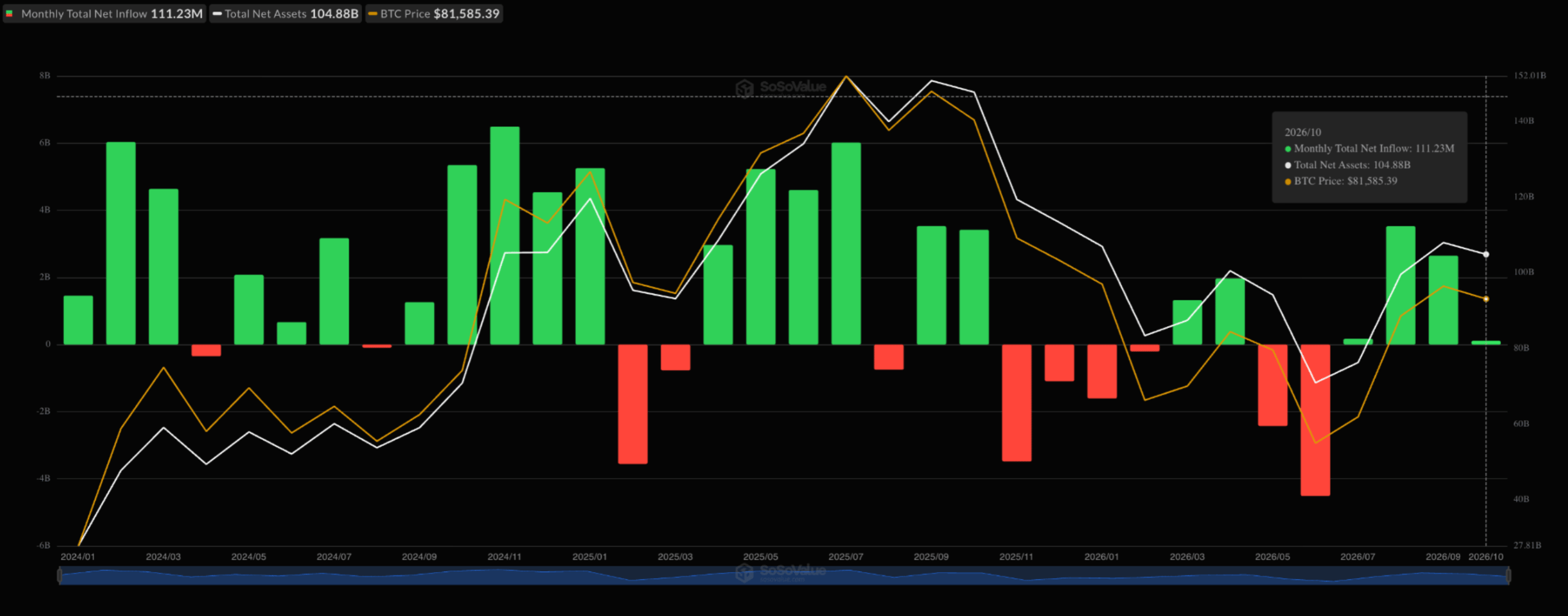
As of October 28, US spot Bitcoin ETFs have recorded 22 monthly inflows and 11 monthly outflows since their inception in January 2024, with total net flows of $104.9 billion. Meanwhile, private and public companies hold $103.7 billion and $22.8 billion in Bitcoin, respectively. These substantial holdings by ETFs and corporate companies, with some purchases financed through equity issuance, debt, or preferred securities, support demand.
However, prolonged correction in Bitcoin could weaken their holding, as recently seen with Strategy offloading some BTC for cash reserves. A potential wave of rate hikes could limit the liquidity available to these institutions, slowing their accumulation or even turning these holdings into a source of supply.

Expert outlook: WisdomTree’s Director of Digital Assets Research on Bitcoin’s resilience amid ETFs, AI risks
In an exclusive interview with FXStreet, I asked Dovile Silenskyte, Director of Digital Assets Research at WisdomTree, about his Bitcoin outlook as broader market conditions remain uncertain.
- Bitcoin's four-year cycle suggests that the bear market could end in late 2026, but the market faces downside pressure with Fed rates and geopolitical risks in focus. Could Bitcoin spot exchange-traded funds (ETFs), corporate DATs, and government-level holdings offset these macro risks?
What sets this cycle apart is how demand reaches Bitcoin. Established investment portfolios, corporate balance sheets and sovereign strategies now offer channels that could help it weather macroeconomic pressure.
Spot ETFs make it easier for investors to allocate through familiar market infrastructure. Corporate treasuries can bring longer-term strategic demand, while sovereign holdings, if retained, could reduce potential selling pressure. Against Bitcoin’s limited supply, sustained buying and holding through these channels could support prices even as interest-rate uncertainty and geopolitical tensions weigh on risk appetite.
However, structural support does not remove cyclical risk. ETF flows can reverse, and corporate buying remains sensitive to financing conditions. A broader investor base gives Bitcoin more potential sources of demand when sentiment improves; it does not put a floor under prices.
A late-2026 bottom, therefore, remains a scenario, not a dependable forecast. The stronger bullish case rests on institutional adoption [combined] with improving global liquidity. If real yields fall and monetary conditions ease, Bitcoin could benefit from structural demand and a more supportive macro backdrop.
- AI-related debt issuance is expected to hit $500 billion in 2026, raising concerns about mounting pressure on bond and credit markets. Could the AI investment boom tighten financial conditions, divert capital from speculative assets, and weigh on Bitcoin?
AI investment could compete with Bitcoin for capital in the near term, but their growth need not be mutually exclusive. Investors can fund the AI buildout while increasing their exposure to Bitcoin.
The immediate risk lies in financing conditions. Heavy borrowing to fund AI infrastructure could push financing costs higher if debt supply outstrips investor demand. Nevertheless, more issuance does not automatically mean tighter financial conditions. The proceeds fund investment and circulate through the economy. What matters is whether markets can absorb the debt and whether the projects generate returns that justify the borrowing.
Over time, the more significant opportunity is stronger productivity. If AI delivers efficiency gains that lift output and ease inflationary pressure, it could create a more supportive backdrop for investment, including Bitcoin. That is a plausible outcome, rather than a guaranteed dividend from AI spending.
Bitcoin’s investment case also rests on different foundations. It offers exposure to a scarce digital asset, rather than corporate earnings or an issuer’s ability to repay debt. Its appeal therefore extends beyond the technology spending cycle.
Key takeaways: What you need to know
Before considering all things bearish, Bitcoin shows strong resilience, holding above key support levels amid broader market uncertainties. The key difference in the next potential rate hike cycle for Bitcoin is the institutional demand, which could support the next sustainable upside.
However, these funds may not be able to defend for a long period of rate hikes as the market anticipates another 25-basis-point increase before the end of 2026.
So, the real test is whether Bitcoin's institutionalization can withstand the next liquidity shock without repeating the extreme drawdowns of previous cycles.
Bài viết đề xuất


