


Bitcoin Price Forecast: BTC reclaims $81,000 as traders await Fed policy decision, Big Tech earnings
- Bitcoin reclaims $81,000 on Wednesday, extending its recovery as investors await the Fed’s policy decision and upcoming Big Tech earnings.
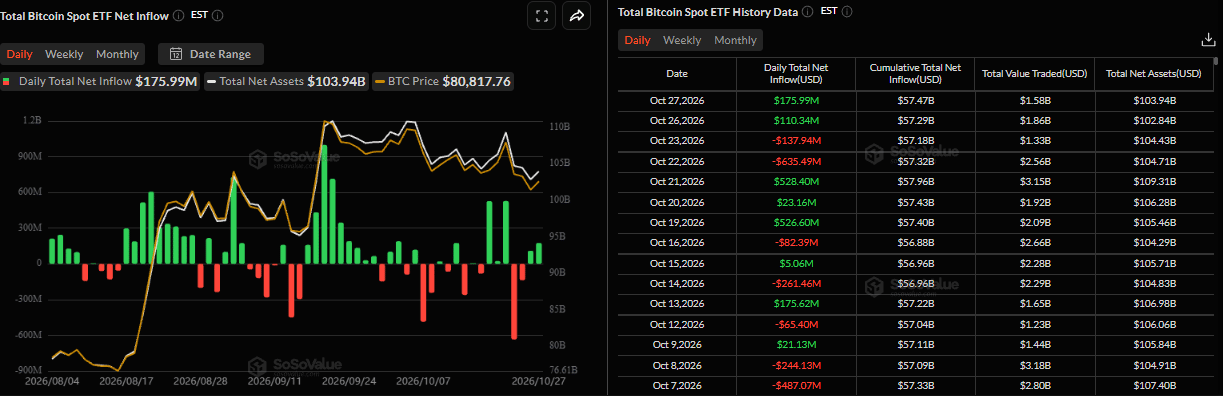
- Spot Bitcoin ETFs record an inflow of $175.99 million on Tuesday, marking a second consecutive day of inflows.
- K33 Research report highlights low market participation and investor inactivity as key concerns, warning of an impending surge in volatility.
Bitcoin (BTC) reclaimed $81,000 on Wednesday, extending its recovery as investors wait for the Federal Reserve (Fed) monetary policy decision and upcoming Big Tech earnings. Institutional demand showed mild bullish signs, with spot Bitcoin Exchange Traded Funds (ETFs) recording a second consecutive day of inflows this week.
Meanwhile, a K33 Research report highlights low market participation and investor inactivity as key concerns, warning that a volatility expansion could be approaching for the Crypto King.
Institutional demand remains cautiously bullish ahead of Fed rate decision
Institutional demand for Bitcoin remains cautiously bullish. SoSoValue data showed that spot Bitcoin ETFs recorded inflows of $175.99 million on Tuesday, up from $110.34 million on Monday, indicating modest institutional buying interest. However, inflows remain less substantial than last week, suggesting investors are taking a cautious approach ahead of the US Federal Reserve’s (Fed) interest rate decision later on Wednesday.
The Fed is widely expected to keep its benchmark interest rate unchanged at the current target range of 3.75% to 4.00% on Wednesday. According to the CME FedWatch tool, markets are pricing in a 90.6% probability of a rate hold at the October meeting, while the probability of a December rate hike stands at 84.4%. Traders will closely monitor Fed Chair Kevin Warsh’s remarks in his press conference for clues about the central bank’s economic outlook and future monetary policy trajectory.
A hawkish tone could weigh on risk appetite and put pressure on BTC, while a more dovish stance could support BTC’s ongoing recovery.
Meanwhile, tensions in the Middle East have also kept BTC traders cautious. The US has told several Gulf Arab countries to be prepared for a “short, intense military campaign” after the US midterm elections, the Wall Street Journal reported.
The developments have supported crude oil prices, with West Texas Intermediate (WTI) rising more than 1% on the day to around $101 per barrel. Higher oil prices could fuel inflation concerns, dampen risk appetite and cap BTC.
Eyes on Big Tech earnings
Market participants also turn their attention to major technology companies’ earnings reports. Microsoft and Alphabet are due to report their Q3 earnings on Wednesday, followed by Amazon on Thursday.
Results that justify continued heavy investment in Artificial Intelligence (AI) could ease concerns over hyperscaler valuations and support risk appetite. Conversely, disappointing figures could deepen the ongoing AI-driven market sell-off and weigh on risk-sensitive assets such as Bitcoin.
Calm before the storm
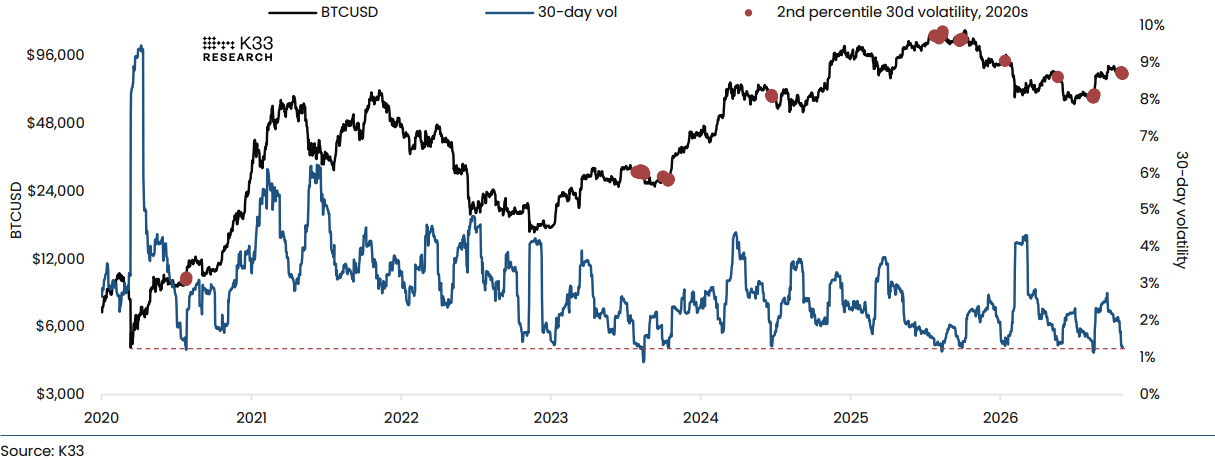
K33 Research report on Tuesday highlighted low market participation and investor inactivity as key concerns affecting BTC prices, warning that a volatility expansion could be approaching.
The 30-day volatility of perpetual Open Interest (OI) is at 1.3%, the 26th lowest reading since June 2021, with 30-day price volatility in the 2nd percentile of this decade. In addition, trading volumes have also dipped to lows not touched between March 2024 and June 2026, as traders remain hands-off.
“Calm like this lets leverage build gradually until a price move forces positions to close and pushes prices further. Regimes this quiet rarely last for long, so a volatility expansion looks likely soon. This also fits well with the frantic pace of the upcoming event calendar, setting the stage for prices to once again start swinging,” the analyst added.
Bitcoin technical outlook: Mild bullish signs
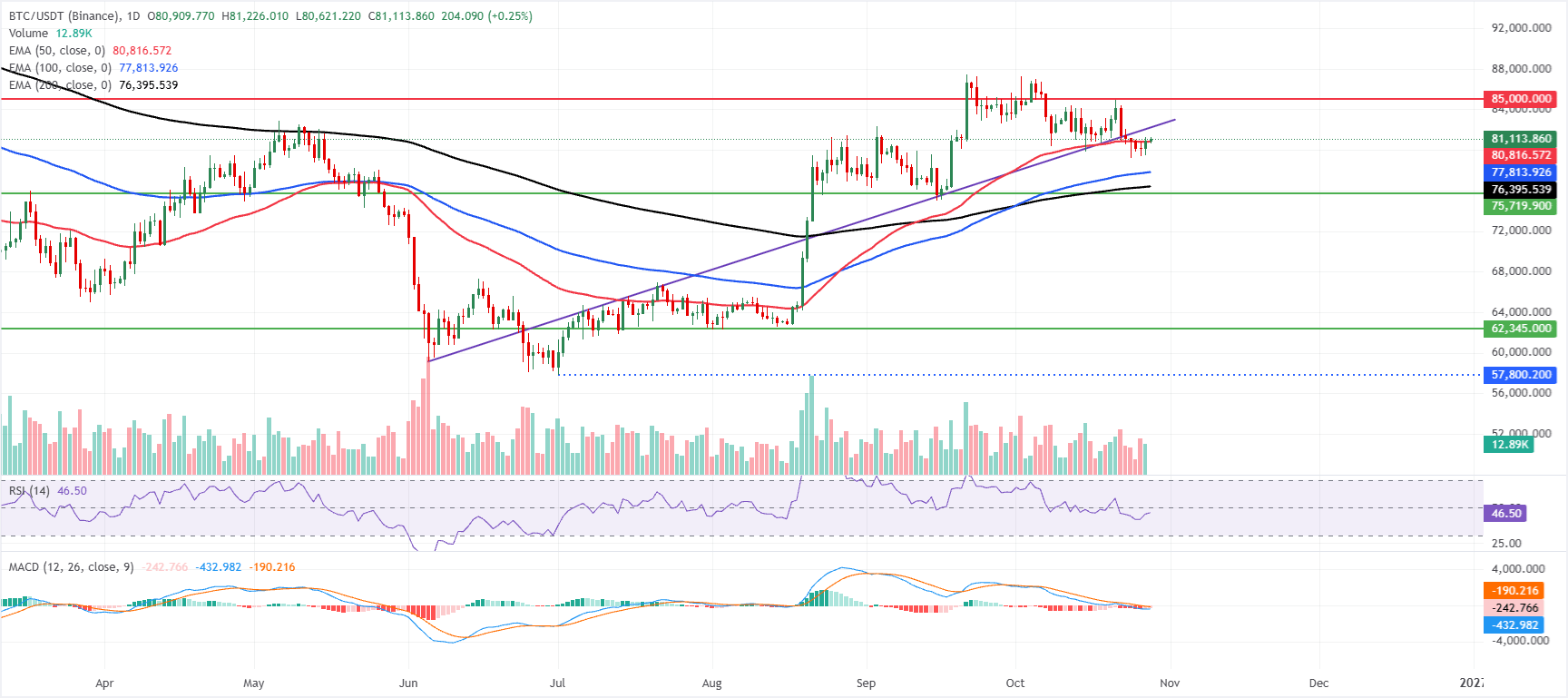
Bitcoin price trades at $81,113 on Wednesday, holding a constructive bullish bias as it consolidates above a tight cluster of Exponential Moving Averages (EMAs). The 50-day EMA at $80,816, together with the 100-day EMA at $77,813 and the 200-day EMA at $76,395, sit comfortably below spot and suggest that the broader uptrend remains supported despite the recent pullback.
Momentum is not aggressive, with the Relative Strength Index (RSI) hovering around 46 and Moving Average Convergence Divergence (MACD) still in negative territory, which hints more at consolidation than at a fresh impulsive leg higher for now.
On the topside, the first notable hurdle emerges at the horizontal resistance near $85,000, where prior supply has capped advances and which now represents the key level bulls need to clear to reassert upside traction.
On the downside, initial demand is expected around the 50-day EMA at $80,816, with deeper support then seen at the 100-day EMA at $77,813 and the 200-day EMA near $76,395; a daily close below this EMA belt would seriously undermine the prevailing bullish structure and open the door to a more pronounced correction.
(The technical analysis of this story was written with the help of an AI tool. Know more.)
Bitcoin, altcoins, stablecoins FAQs
Bitcoin is the largest cryptocurrency by market capitalization, a virtual currency designed to serve as money. This form of payment cannot be controlled by any one person, group, or entity, which eliminates the need for third-party participation during financial transactions.
Altcoins are any cryptocurrency apart from Bitcoin, but some also regard Ethereum as a non-altcoin because it is from these two cryptocurrencies that forking happens. If this is true, then Litecoin is the first altcoin, forked from the Bitcoin protocol and, therefore, an “improved” version of it.
Stablecoins are cryptocurrencies designed to have a stable price, with their value backed by a reserve of the asset it represents. To achieve this, the value of any one stablecoin is pegged to a commodity or financial instrument, such as the US Dollar (USD), with its supply regulated by an algorithm or demand. The main goal of stablecoins is to provide an on/off-ramp for investors willing to trade and invest in cryptocurrencies. Stablecoins also allow investors to store value since cryptocurrencies, in general, are subject to volatility.
Bitcoin dominance is the ratio of Bitcoin's market capitalization to the total market capitalization of all cryptocurrencies combined. It provides a clear picture of Bitcoin’s interest among investors. A high BTC dominance typically happens before and during a bull run, in which investors resort to investing in relatively stable and high market capitalization cryptocurrency like Bitcoin. A drop in BTC dominance usually means that investors are moving their capital and/or profits to altcoins in a quest for higher returns, which usually triggers an explosion of altcoin rallies.
Bài viết đề xuất


