


Ripple Price Forecast: XRP gains upside momentum as ETF inflows return
- XRP rebounds toward $1.40, supported by broader risk-on sentiment.
- Interest in XRP spot ETFs mildly returns as inflows total $3 million on Tuesday.
- XRP upside remains limited despite the minor uptick, weighed down by declining retail interest.
Ripple (XRP) edges up above $1.38 at the time of writing on Wednesday as crypto prices generally recover from tariff-triggered doldrums. The remittance token is up over 5% from the weekly low of $1.31, reflecting growing interest among institutional investors.
Still, the token's upside appears limited below the immediate resistance at $1.40, reflecting persistent risk-off sentiment amid waning retail demand.
Renewed institutional interest strengthens XRP’s short-term outlook
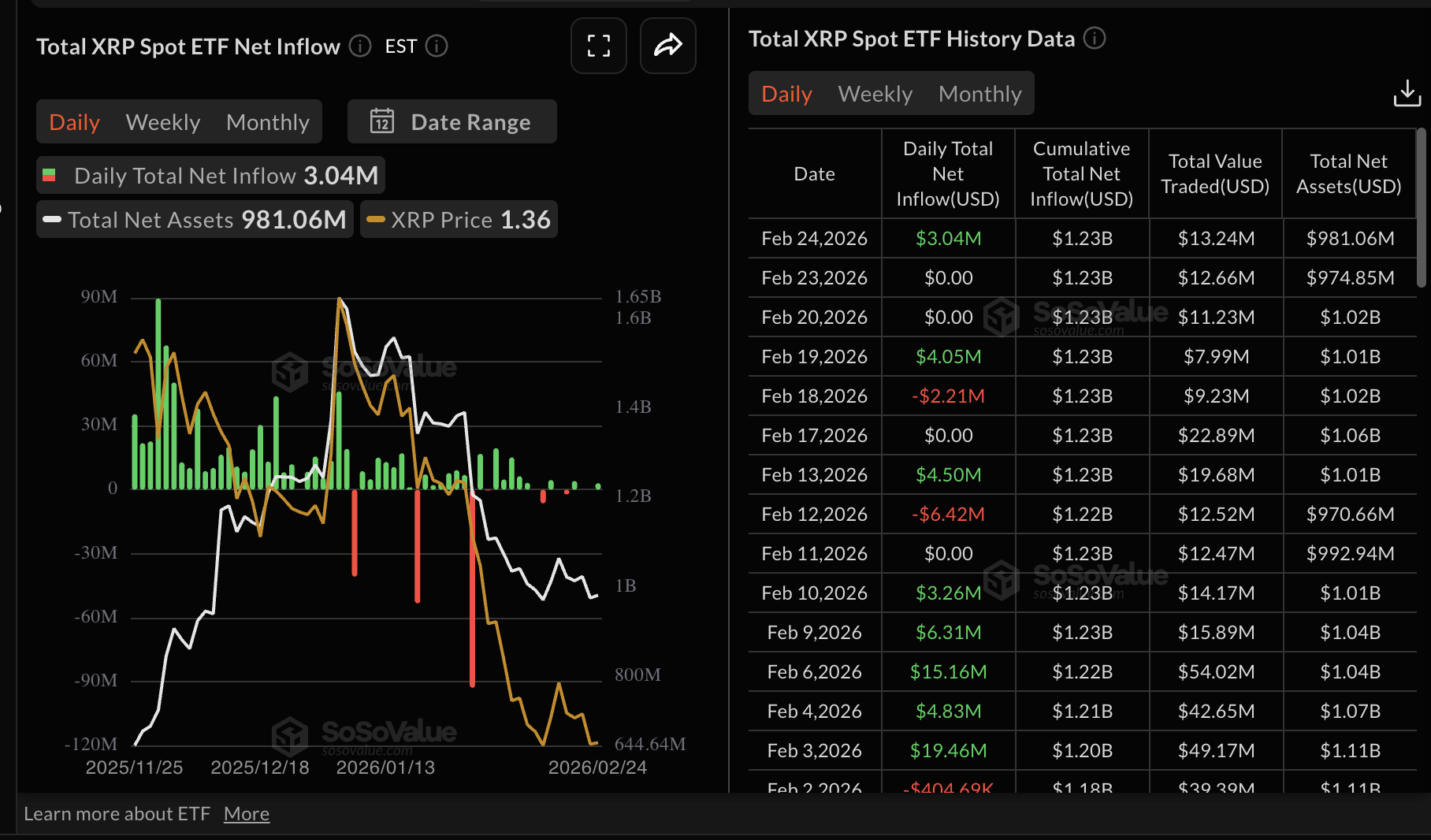
Institutional investors are regaining interest in XRP as evidenced by the resurgence of inflows into spot Exchange-Traded Funds (ETFs). SoSoValue data show that inflows totaled $3 million on Tuesday, all of which were accounted for by Bitwise’s XRP ETF.
Cumulative inflows hold steady at $1.23 billion, while total assets under management increased slightly to $981 million. Steady inflows suggest risk appetite is improving, which could boost sentiment and increase the probability of a price recovery.
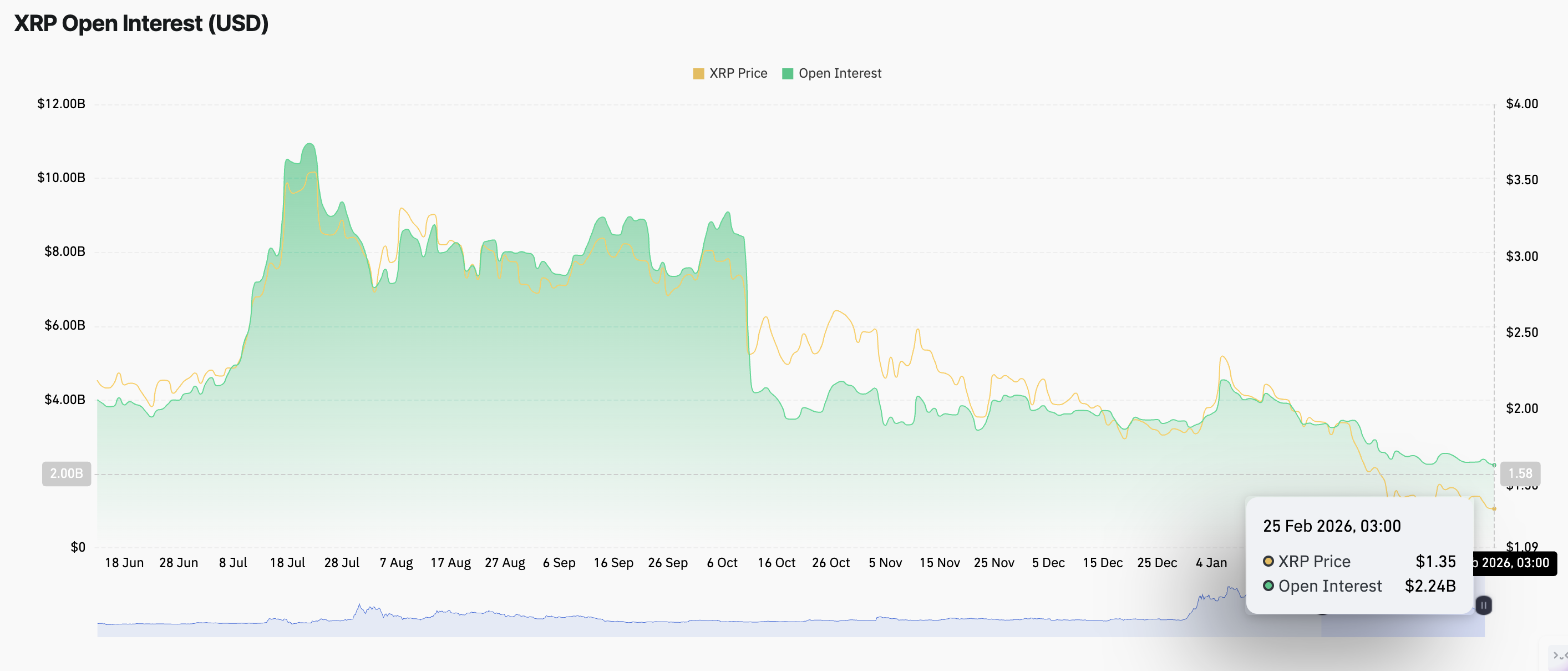
Meanwhile, the derivatives market continues to weaken, with futures Open Interest (OI) falling to $2.24 billion on Wednesday from $2.29 billion the previous day. The OI has persistently declined from the record $10.94 billion seen in July, which also coincided with the all-time high of $3.66, undermining retail interest in the remittance token.
Technical outlook: XRP eyes short-term breakout above $1.40
XRP hovers above $1.38 amid an ongoing upside correction. Despite the minor recovery from the daily opening of $1.35, the token holds in a generally bearish trend below the clustered 50-day, 100-day and 200-day Exponential Moving Averages EMAs, which continue to slope lower and cap the upside.
A long-running descending resistance trendline from above $3.66 (record high) remains intact, reinforcing the broader downtrend as price action grinds beneath its projected break area around $2.05.
Momentum conditions show only modest improvement as the Moving Average Convergence Divergence (MACD) line has turned marginally positive above the signal line on the daily chart.
At the same time, the Relative Strength Index (RSI) rises to 39 on the same chart, consistent with a cautious short-term outlook.
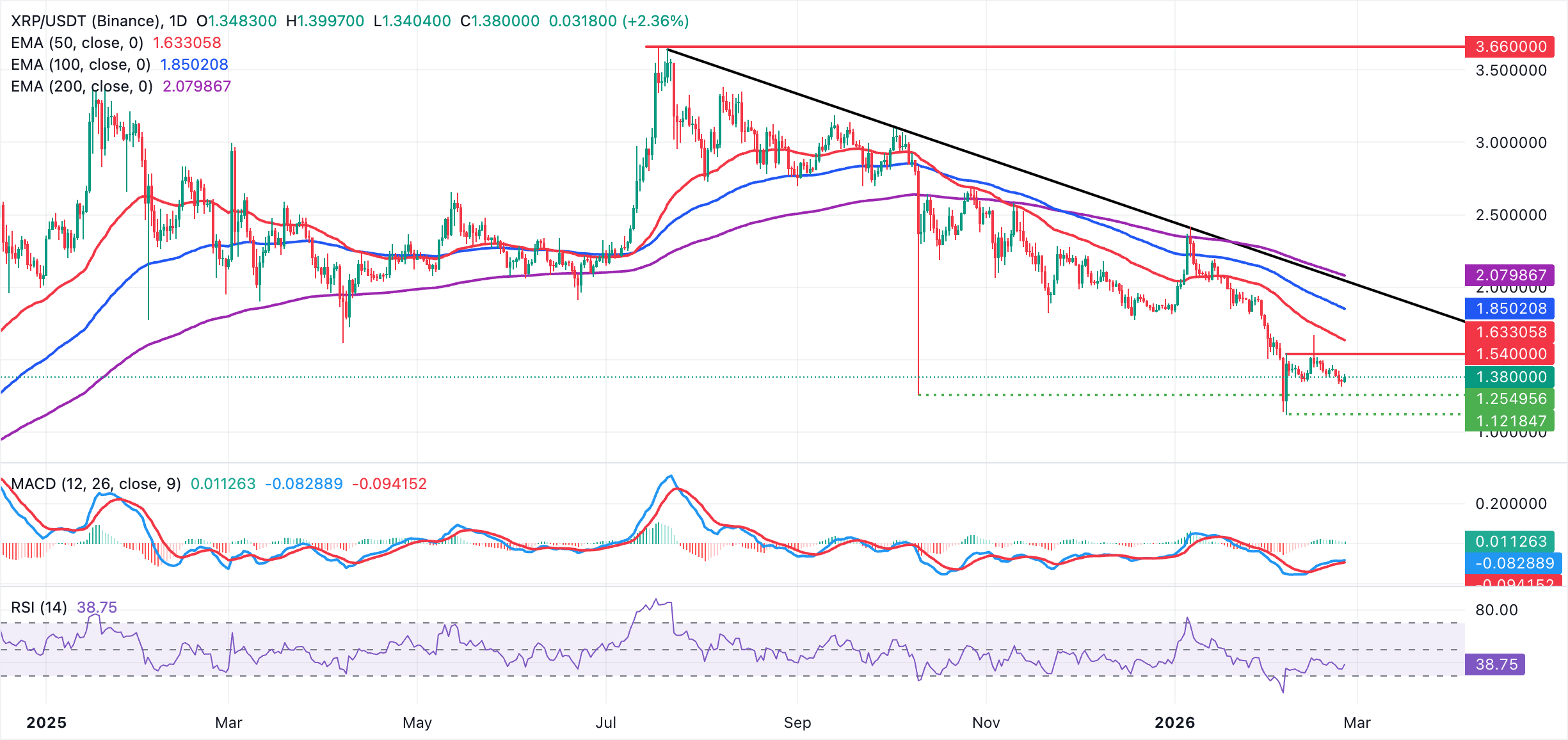
Immediate resistance emerges near the recent reaction highs around $1.40, where prior rebounds stalled, with the descending trend line and the 50-day EMA reinforcing a wider supply zone toward $1.63.
A daily close above this band would open the way toward the more strategic barrier highlighted by the 200-day EMA at $2.08. Still, initial support lies at Monday’s low of $1.33, with a break exposing October 10 low at $1.25.
Crypto ETF FAQs
An Exchange-Traded Fund (ETF) is an investment vehicle or an index that tracks the price of an underlying asset. ETFs can not only track a single asset, but a group of assets and sectors. For example, a Bitcoin ETF tracks Bitcoin’s price. ETF is a tool used by investors to gain exposure to a certain asset.
Yes. The first Bitcoin futures ETF in the US was approved by the US Securities & Exchange Commission in October 2021. A total of seven Bitcoin futures ETFs have been approved, with more than 20 still waiting for the regulator’s permission. The SEC says that the cryptocurrency industry is new and subject to manipulation, which is why it has been delaying crypto-related futures ETFs for the last few years.
Yes. The SEC approved in January 2024 the listing and trading of several Bitcoin spot Exchange-Traded Funds, opening the door to institutional capital and mainstream investors to trade the main crypto currency. The decision was hailed by the industry as a game changer.
The main advantage of crypto ETFs is the possibility of gaining exposure to a cryptocurrency without ownership, reducing the risk and cost of holding the asset. Other pros are a lower learning curve and higher security for investors since ETFs take charge of securing the underlying asset holdings. As for the main drawbacks, the main one is that as an investor you can’t have direct ownership of the asset, or, as they say in crypto, “not your keys, not your coins.” Other disadvantages are higher costs associated with holding crypto since ETFs charge fees for active management. Finally, even though investing in ETFs reduces the risk of holding an asset, price swings in the underlying cryptocurrency are likely to be reflected in the investment vehicle too.
(The technical analysis of this story was written with the help of an AI tool.)
Bài viết đề xuất


