


Bitcoin resumes Nasdaq correlation as macro pressures threaten $82,500 support
- Bitcoin’s correlation with the Nasdaq has strengthened again amid rising US inflation and sell-offs in AI-related stocks.
- IBIT options is challenging Deribit, accounting for 60% of Bitcoin's options open interest growth since Q3 2025.
- Bitcoin is defending the $82,500 support, but a sustained break below could expose the low $70,000 range as volatility returns.
Bitcoin's (BTC) correlation with the Nasdaq is rising again after last week's decline alongside tech stocks, even as macro pressures place the $82,500 support at risk.
Bitcoin remains rangebound as Nasdaq correlation returns
In a report on Tuesday, K33 Research highlighted that Bitcoin has resumed its correlation with the tech-heavy Nasdaq after last week's price movements.
The renewed correlation follows a sharp semiconductor sell-off and hotter-than-expected US inflation data, which contributed to the Nasdaq’s worst weekly performance since the week of April 6, 2025. Bitcoin also fell roughly 2% over the past week, with average daily spot trading volume down 1% to $2.5 billion.
“Zooming out to a two-week horizon, BTC and Nasdaq returns sit at almost equal levels, pointing to a return to the relatively correlated regime seen from February to mid-August,” K33 wrote.
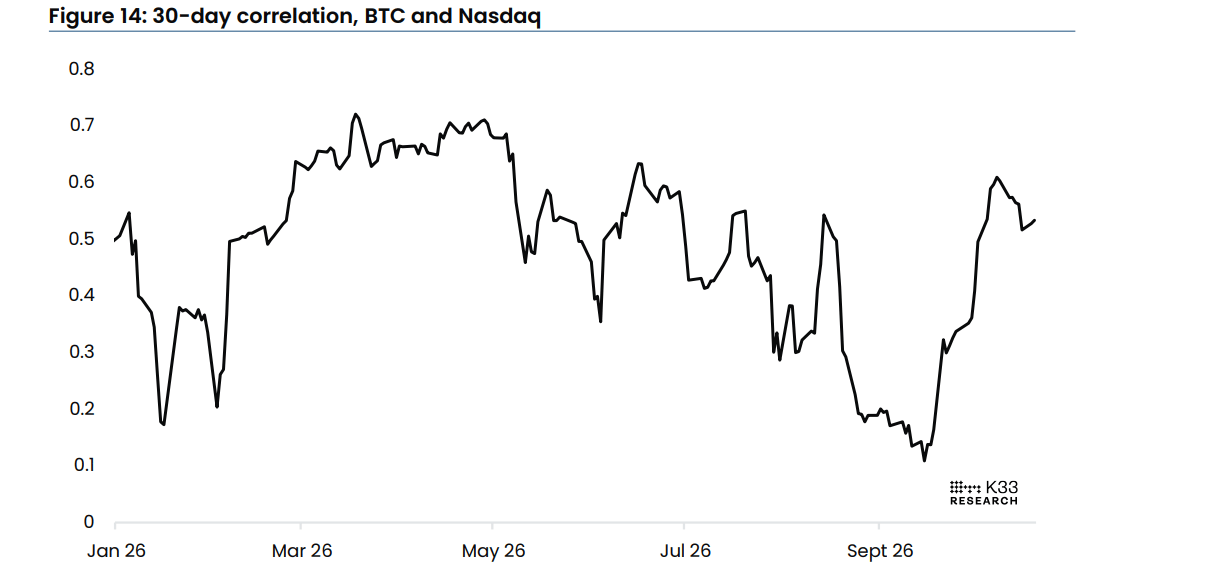
Despite the weak participation, the report maintained that Bitcoin remains attractively priced at current levels, although low activity increases the likelihood of further choppy trading.
K33 also examined the growing influence of options tied to BlackRock’s iShares Bitcoin Trust (IBIT), which has increasingly challenged crypto exchange Deribit as the leading venue for Bitcoin options.
Bitcoin options open interest has remained between approximately 700,000 BTC and 1.1 million BTC since the third quarter of 2025, with IBIT accounting for around 60% of the increase.
Deribit's share of open interest stood at 70% before IBIT options launched, but has since dropped to 43%.
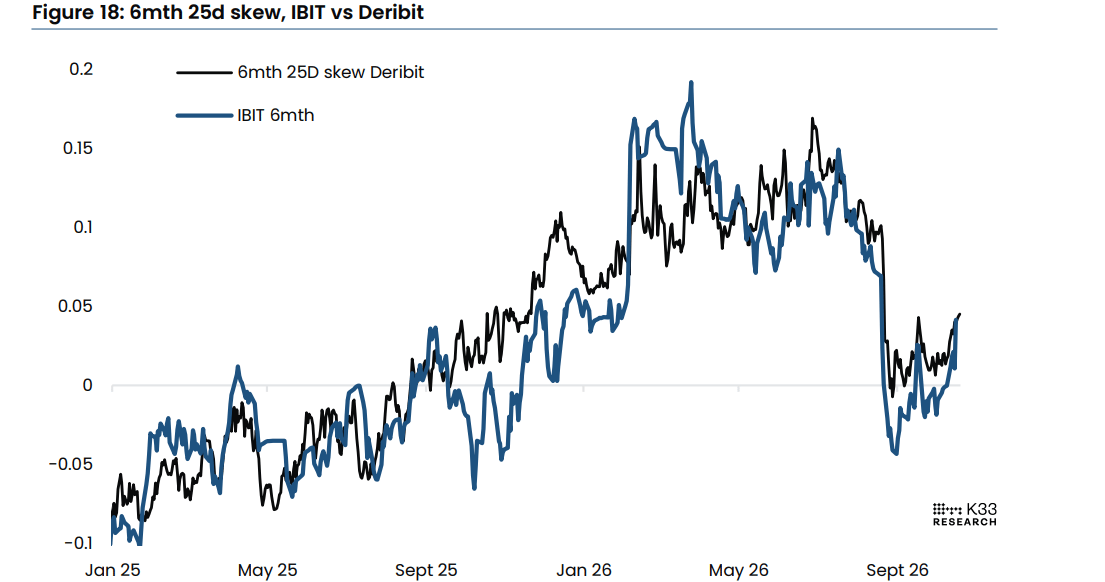
IBIT’s options open interest reached 434,922 BTC, equivalent to approximately 54% of its Bitcoin assets under management.
“A ratio of 54% might seem extreme, but it is actually low compared to the largest ETFs on other assets,” the report stated.
Inflation risks threaten the $82,500 support level
Despite a renewed correlation with the Nasdaq, Bitcoin is currently defending the $82,500 support level, according to a Wintermute’s market update on Tuesday. The firm stated that Bitcoin could struggle to hold this range, as upcoming macro events could spark volatility.
“The Fed next week, the midterms and Q3 earnings all land in the next few weeks, and we don’t think the range holds through them,” Wintermute wrote.
The report identified $87,000 as the breakout threshold, while a sustained move below $82,500 could expose the low $70,000 range.
Wintermute said a less aggressive Federal Reserve response, combined with strong third-quarter earnings, could support a move above $87,000, while higher yields and continued weakness in technology stocks could push Bitcoin lower.
Among altcoins, the report pointed to growing weakness, with its broader altcoin cohort falling 5.69% over the week.
“Altcoins are starting to feel heavy again, with the whole spectrum cohort selling off since topping around 14 days ago and down 5.69% on the week,” Wintermute added.
The firm observed that capital was increasingly moving into Bitcoin and Ethereum (ETH), while flows into altcoins weakened. Higher-quality large-cap tokens were the only exception, attracting some longer-term investors amid increased liquidity.
Wintermute warned that altcoins could struggle to recover even if Bitcoin rallies, while a broader market sell-off could leave them exposed to further losses.
Bitcoin is trading at $82,600, up 0.8% in the past 24 hours at the time of writing.
Bài viết đề xuất


