


Ethereum Price Forecast: Whales buy the dip amid rising short bets
Ethereum price today: $2,010
- Ethereum whales accumulated more than 520K ETH between February 4 and 8, offsetting distribution from retail investors.
- The Net Taker Volume on Binance has returned to negative territory after briefly flipping positive in January.
- ETH could find support at $1,740 after seeing a rejection around $2,100.
Following one of Ethereum's (ETH) largest weekly drawdowns, whales are slowly returning to action alongside a drop in retail selling pressure.
After slightly selling into the decline at the start of the month, whales or wallets with a balance of 10K-100K ETH began buying the dip last Wednesday as prices crashed further. Between February 4 and 8, these entities collectively accumulated over 520K ETH — around the same time that ETH rebounded from below $1,800 to above $2,000.
-1770763635220-1770763635222.png)
During the period, retail investors — wallets holding 100-1K ETH and 1K-10K ETH — distributed 233K ETH, meaning the buying pressure from whales outweighed the distribution of retail investors for the first time since the beginning of the year. Historically, prices have often seen a recovery when retail sell pressure weakens and whales continue buying the dip.
However, the market remains fragile, as ETH trades below the average cost basis of investors at $2,310 and the realized price of whales.
Additionally, ETH Net Taker Volume on the crypto exchange has returned to negative territory after briefly flipping positive in January, indicating shorts are building up positions again. The metric tracks the difference between buyers and sellers purchasing ETH futures using market orders.
-1770763758308-1770763758309.png)
Meanwhile, the ETH Coinbase Premium has remained at a discount since December, indicating continued selling pressure from US investors.
Ethereum Price Forecast: ETH sees rejection at $2,100, eyes $1,740 support
Ethereum saw $61.9 million in liquidations over the past 24 hours, led by $46.5 million in long liquidations, per Coinglass data.
ETH saw a rejection around $2,100 and is looking to decline below the $2,000 psychological level on Tuesday. Such a move could see ETH find support around $1,740.
On the upside, ETH has to overcome the $2,100 resistance to rise toward $2,380.
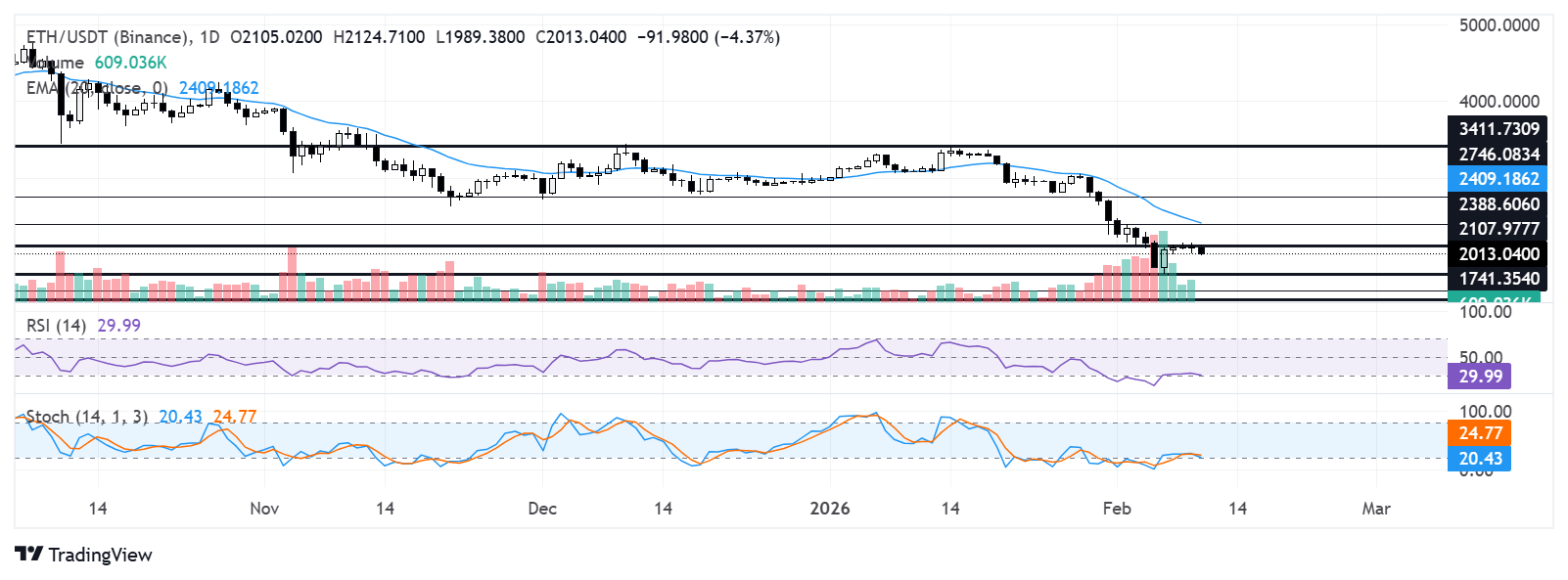
The Relative Strength Index (RSI) and Stochastic Oscillator (Stoch) are around oversold territory, indicating a dominant bearish momentum.
Bài viết đề xuất


