


Ripple’s DeFi shift in focus: Navigating XRPL EVM sidechain growth, XRPFi migration and liquidity
- The XRPL EVM sidechain emerges as a Layer-2 network for the mainnet, enabling the ecosystem to scale native DeFi infrastructure.
- Over 90 entities actively connect to the XRPL EVM, spanning DeFi, RWAs, DAOs, and launchpads.
- XRPL EVM sidechain taps mXRP liquidity token, mirroring the security, reliability, and scalability of the primary protocol.
- Macroeconomic uncertainty, regulatory bottlenecks and the bear market trend limit XRP's near-term performance.
Ripple (XRP) has continued to trade under pressure, extending its decline by approximately 63% from the record high of $3.66 in July. The remittance token is trading above support at $1.35, while its upside appears limited by key supply zones, starting with $1.40, at the time of writing on Tuesday.
XRP’s downside woes align with the broader cryptocurrency market, with the capitalization falling to $2.28 trillion, down from the record $4.4 trillion, according to CoinGecko data.
However, as risk-off sentiment persists, restraining investors to the sidelines, a closer look at the XRP ecosystem reveals key structural changes, developments, and value integrations that could change how investors interact with the native XRP Ledger (XRPL) protocol.
This article explores the development and structural changes in the XRP ecosystem, dissecting the potential impact of the XRPL EVM sidechain, the XRPFi migration, native yield, interoperability via Axelar, and on-chain liquidity.
XRPL EVM sidechain and the XRPFi migration
Ripple’s XRP Ledger (XRPL) has, since its inception, lived up to its ambition of speed, scalability, low transaction costs, security, reliability and decentralization. With these unique features, the XRPL has been recognised for its role in advancing payment and settlement systems.
Yet, as blockchain technology evolved over the years, Ripple noticed a growing demand for more programmable, flexible, and customizable solutions to support existing and new use cases.
It is this growing tail of demand that pushed Ripple in a new direction, developing the XRPL EVM sidechain, which entails the integration of programability into the protocol mainnet.
The XRPL EVM Sidechain officially went live on June 30, 2025, bridging the XRPL with Ethereum’s Solidity ecosystem.
Ripple describes the XRPL EVM sidechain as a complementary network that supports user needs as blockchain technology evolves. The native XRP token is core to the XRPL EVM sidechain, as it is used to pay fees and support deployment and smart contracts. As such, it is vital to view the XRPL EVM sidechain as a Layer-2 network for the main blockchain, enabling the ecosystem to scale infrastructure, expand use cases, and support the evolving requirements of the blockchain.
The XRPL EVM sidechain is also a powerhouse of interoperability, providing compatibility with XRP and extended exposure to other blockchain ecosystems.
Bringing the gap
The XRPL EVM sidechain is built on three key pillars: Programmability, scalability and interoperability. XRP bridged to the sidechain is natively locked on the XRPL mainnet, while a synthetic version is created for use across the ecosystem’s decentralized applications (dApps). This feature unlocks capital but preserves mainnet integrity.
According to Ripple, more than 90 entities are actively involved in the XRPL EVM, spanning decentralized finance (DeFi), real-world assets (RWAs), launchpads, data & infrastructure, and decentralized and autonomous organisations (DAOs).
The XRP Ledger yield era via Axelar Network
The XRPL EVM sidechain has paved the way for native yield through the RWA-focused project Midas and Interop Labs, which unveiled the mXRP liquid staking token in September. According to a CoinDesk report, the liquid staking product is directly linked to the XRP ecosystem, minted on the sidechain and wrapped under Midas’ developed tokenized certificate framework.
Although there are structural and execution differences compared to liquid staking on the Ethereum network, mXRP provides access to DeFi infrastructure, including verticals such as market-making and liquidity provisioning, via the Axelar network.
mXRP is a liquid, yield-bearing token designed to unlock funds currently idle in the XRP ecosystem, enabling holders to deploy liquidity into DeFi. At launch, mXRP offered up to a 10% APY to on-chain holders while retaining liquidity for institutional-grade custody or use in other ecosystem applications.
The token is issued by Midas under the European Union-approved framework, with deposits managed via Hyperithm, a digital asset gateway for institutions. mXRP is an XRP EVM sidechain token that mirrors the security, reliability, and scalability of the primary blockchain, XRPL.
Axelar Network highlights that XRP custody providers can offer their clients yield through mXRP, while asset managers can diversify their solutions, culminating in enhanced portfolio returns.
Axelar Network offers secure transfers between the XRPL and the XRPL EVM. Interoperability expands this coverage to over 80 additional blockchains. Centralized exchanges (CEXs) and decentralized exchanges (DEXs) can also offer customers a directly XRP-denominated yield product.
Axelar states that “mXRP can be returned to secure custody, deployed as collateral in onchain applications on the XRPL EVM blockchain, or securely transferred to other DeFi ecosystems across more than 80 blockchains connected by Axelar.”
By October, mXRP was the fastest-growing yield product issued by Midas, outpacing earlier-launched products including mAPOLLO, mEDGE, mHYPER, and mMEV.
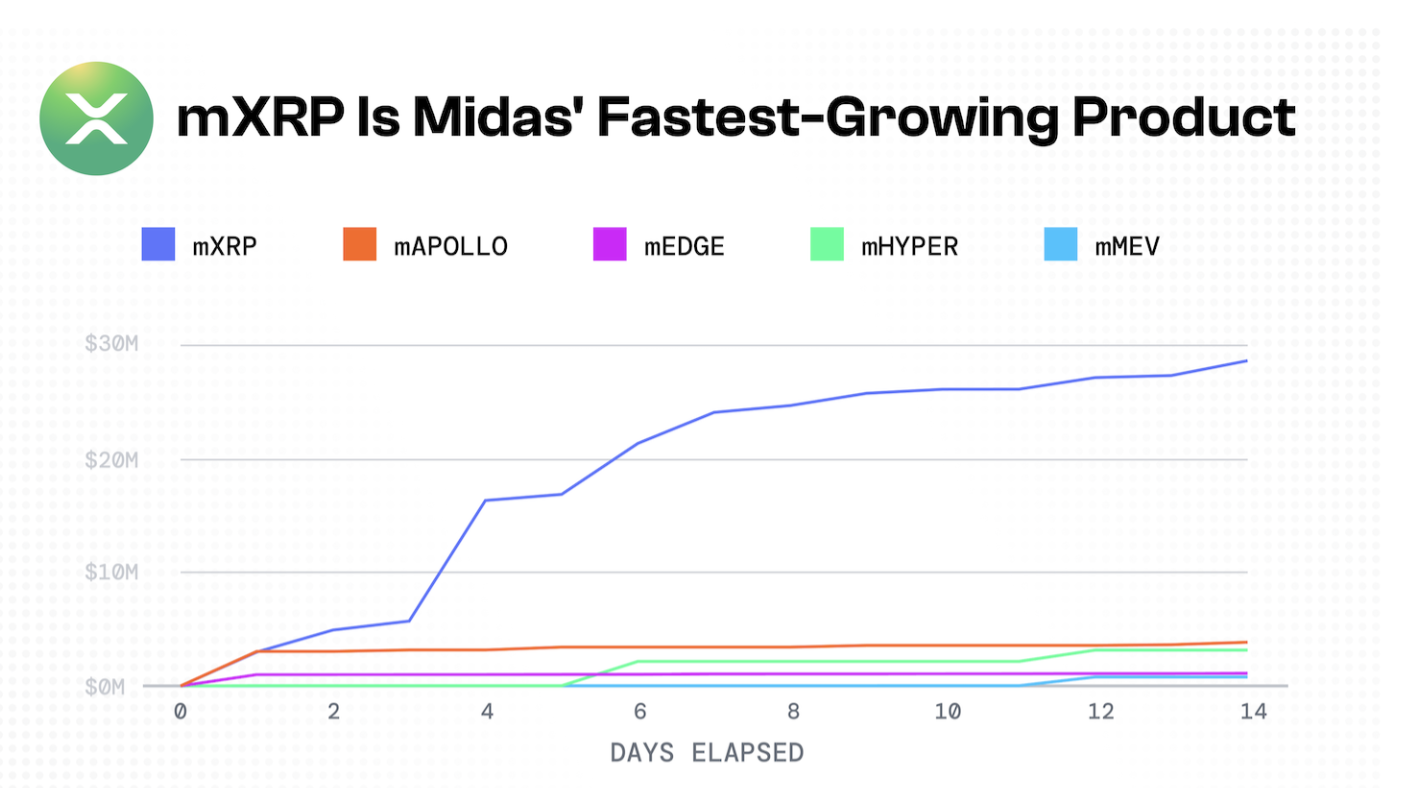
mXRP appeals to institutions and individuals who prefer to access liquidity and earn yield while holding XRP. The token’s use cases can be amplified amid the ongoing volatility and bear market, as investors seeking yield continue to face persistent price drawdowns.
The introduction of mXRP marks a new era for XRP holders, who can now deploy the mXRP liquid staking token across DeFi protocols and earn returns through activities such as lending, liquidity provision, and collateralized strategies.
“The mXRP portfolio is managed using delta-neutral strategies designed to generate XRP-denominated yield without directional exposure to XRP price volatility. These include arbitrage and basis-trading strategies that exploit funding differentials across exchanges or between spot and perpetual markets,” Axelar said in an October release.
XRP Ledger on-chain growth: Focus on XRPL AMM
Ripple’s strategic focus on-chain DeFi is transforming the XRP Ledger into a powerhouse in the sector, driven by a notable increase in liquidity. The protocol’s automated market maker (AMM) infrastructure is experiencing significant growth, with nearly 27,000 active liquidity pools, facilitating seamless trading across a growing ecosystem with more than 16,000 unique tokens.
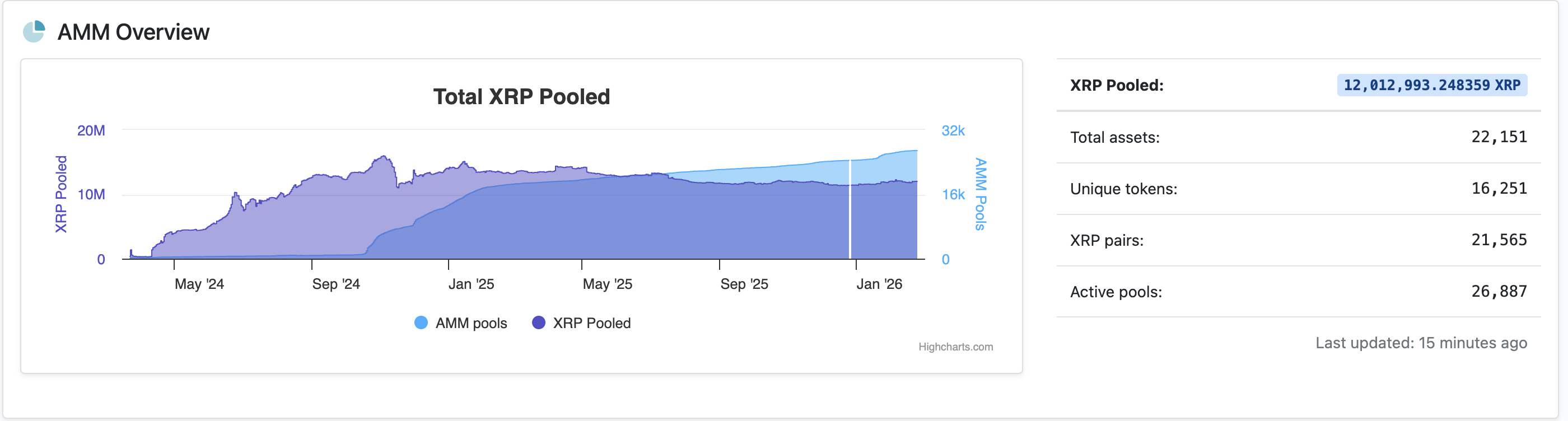
The progressive development of the AMM infrastructure underscores a pivotal shift in the XRPL landscape. Unlike conventional smart contract-based decentralized exchanges (DEXs), the XRPL AMM integrates a protocol-native design that optimizes capital efficiency while reducing execution risk.
XRPL AMM boasts liquidity depth of over 11.5 million XRP, a market that is gradually maturing with ongoing strategic improvements, such as the adoption of single-sided liquidity provision and refined auto-bridging mechanics.
By extension, the XRPL AMM is coming up as a unique bridge between retail and institutional-grade finance, supported by stablecoins like RLUSD. For investors, this means reduced slippage and transaction costs, as well as new yield-bearing opportunities.
Institutional adoption: The RLUSD stablecoin settlement rail
Ripple’s RLUSD has, since its inception in December 2024, emerged as a competitive stablecoin, increasing liquidity on the protocol. The stablecoin’s 'regulatory first' approach under the New York Department of Financial Services (NYDFS) Trust Charter appeals to institutional investors.
RLUSD has been integrated with major custodians, including BNY Mellon and Prime brokerages, ensuring capital stays on-chain while reducing exposure to volatility. Furthermore, the recently announced Mastercard pilot could pave the way for real-time card payments.
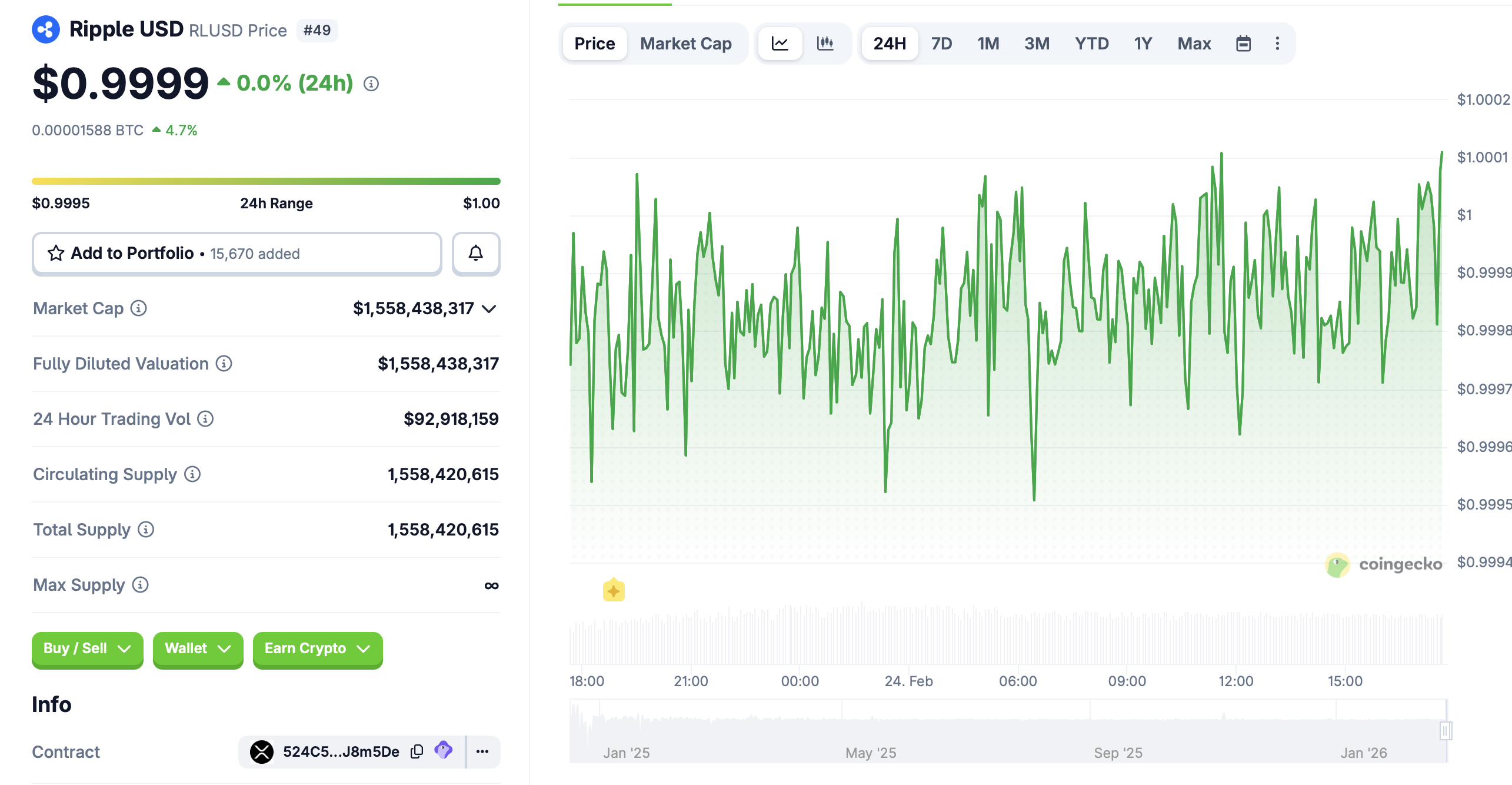
RLUSD market capitalization stands at $1.5 billion, according to CoinGecko, and is available on both the XRP Ledger and Ethereum blockchains.
XRP volatility in focus: Investors on edge as volatility spikes
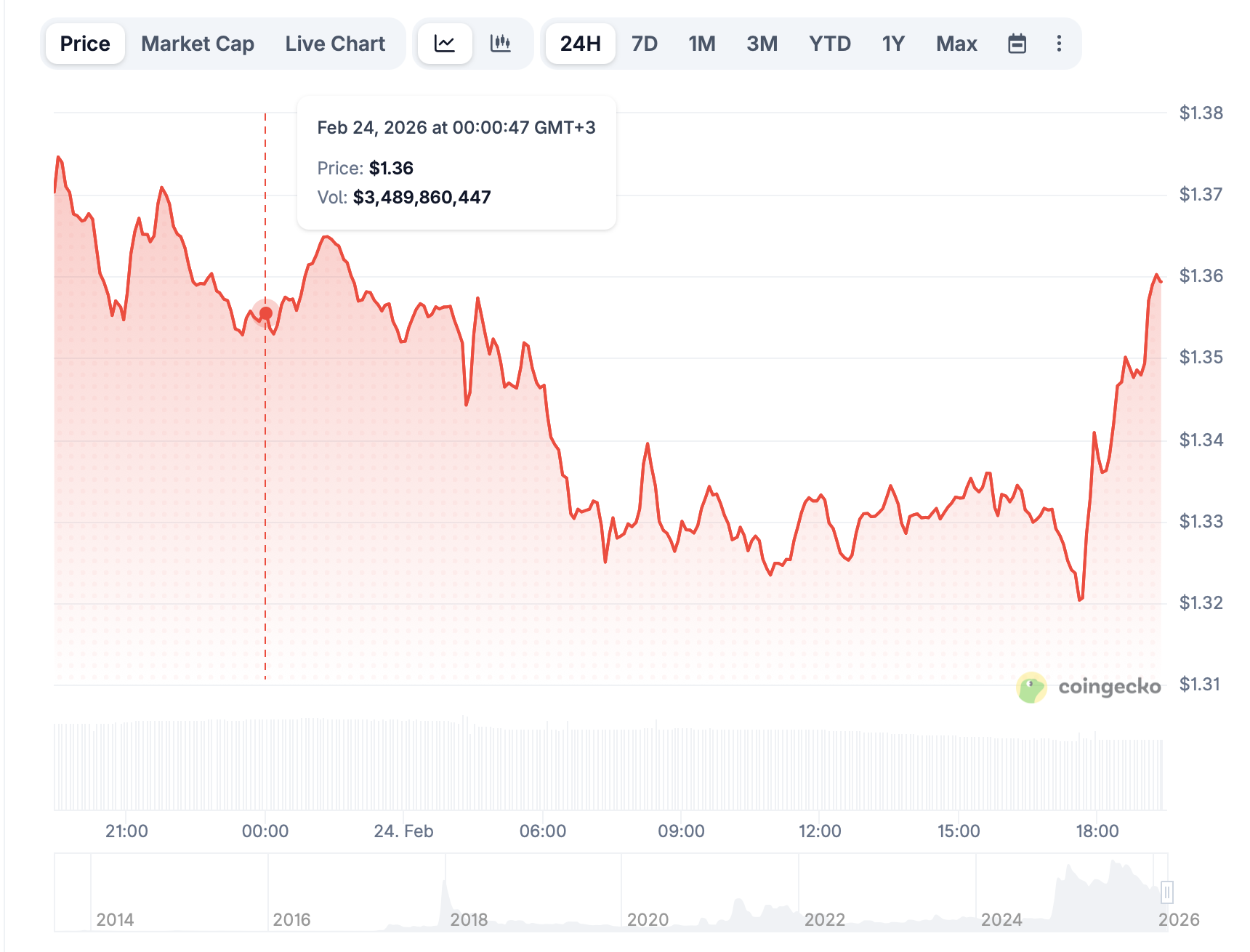
The notable price performance of XRP, which hit a record high of $3.66 in July, has culminated in market doldrums and persistent sell-offs. From the record high of $3.66 reached in July, XRP is down over 63% to $1.33.
Regulatory uncertainty about the fate of the Digital Asset Market Clarity Act (CLARITY Act), macroeconomic headwinds following US President Donald Trump's response to the Supreme Court ruling that most reciprocal tariffs are illegal, geopolitical tensions and bear market trends in the broader cryptocurrency market are some of the factors that contribute to the headwinds keeping XRP in a steady decline.
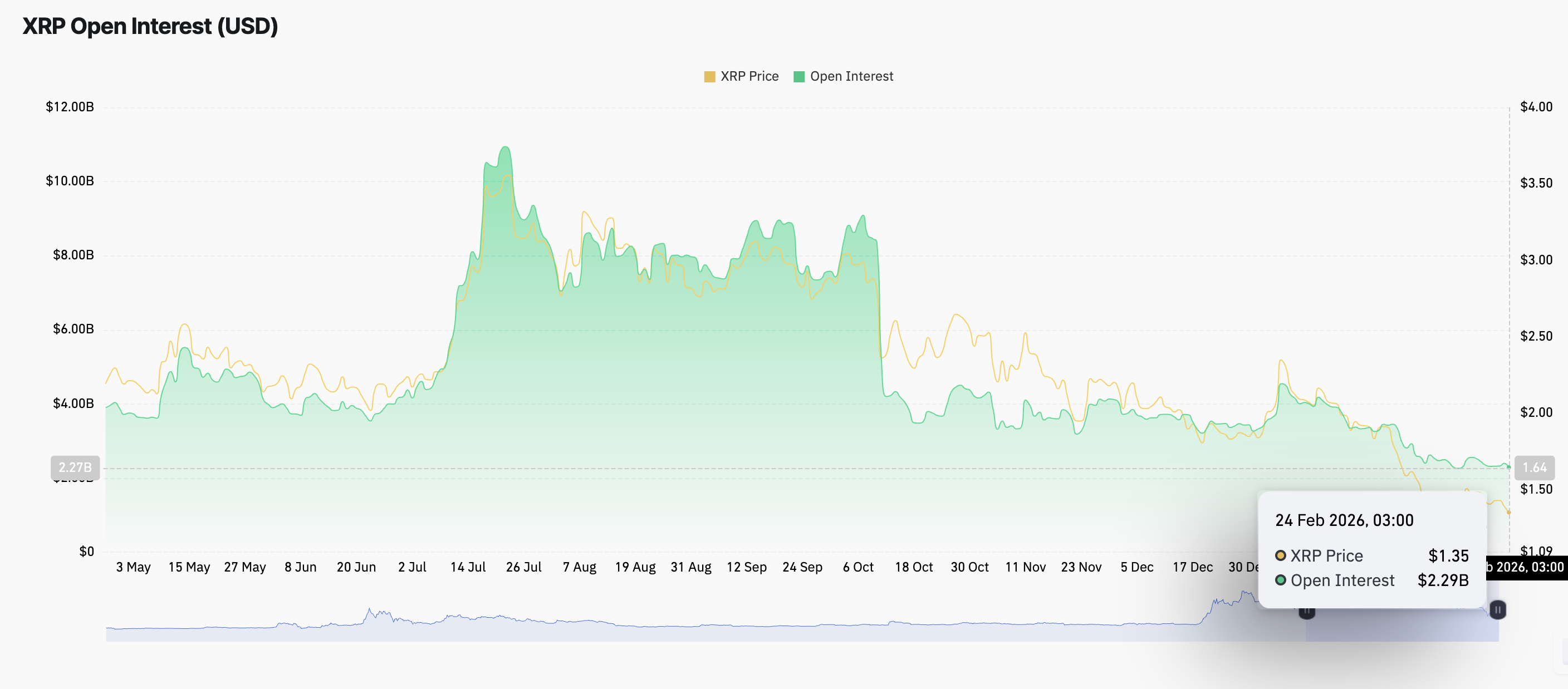
Retail support remains on the back foot, as reflected by futures Open Interest (OI) falling to $2.29 billion on Tuesday, down from $10.94 billion, a record reached in July. This shows that investors lack confidence in XRP and the larger ecosystem, and are unwilling to open new positions, while focusing on reducing their exposure.
Meanwhile, XRP holds below the 50-week Exponential Moving Average (EMA), as well as the 100- and 200-week EMAs, all clustered between $1.40 and $2.08, underscoring a mature downtrend.
The SuperTrend indicator flipped to bearish in December and continues to track lower, reinforcing selling pressure. Meanwhile, momentum remains negative, with the Moving Average Convergence Divergence (MACD) line holding below its signal line, as red histogram bars stabilize.
The Relative Strength Index (RSI) sits near 32, indicating persistent bearish momentum, but has not yet entered extreme oversold territory.
-1771950617717-1771950617718.png)
Initial resistance emerges near the $1.65 area, where recent weekly reaction highs align with the falling 50-week EMA, followed by $1.90 and then the $2.05 region, where the prior trend-line break level converges with the declining medium-term averages.
As long as price holds below these barriers, rallies are vulnerable to renewed supply. On the downside, immediate support is seen at the recent low around $1.33, with a break exposing the next downside focus near $1.20 and then $1.05.
A weekly close back above $1.90 would be needed to ease the current bearish tone and open a more sustained recovery phase toward the $2.05-$2.30 band.
Conclusion
The XRP Ledger’s strategic shift toward a new era of DeFi growth has ushered in new native use cases for ecosystem assets, including XRP, RLUSD and mXRP. The XRPL EVM sidechain enables XRP holders to yield and interact with other protocols without the need for additional bridges.
As with the mainnet XRPL, security, reliability, scalability, and decentralisation remain the core pillars. The developments within the Ripple ecosystem are particularly important during bear markets, allowing holders to stake, lend, borrow, and access liquidity while holding their XRP.
However, negative sentiment in the broader crypto market calls for caution amid the need to protect capital. Macroeconomic uncertainty and regulations remains core hindrance to upside price corrections.
In light of the challenges facing global markets, risk management through strategic asset diversification, the use of stablecoins like RLUSD, and the metered deployment of capital stand out for investors seeking to endure bear-market uncertainty.
Ripple FAQs
Ripple is a payments company that specializes in cross-border remittance. The company does this by leveraging blockchain technology. RippleNet is a network used for payments transfer created by Ripple Labs Inc. and is open to financial institutions worldwide. The company also leverages the XRP token.
XRP is the native token of the decentralized blockchain XRPLedger. The token is used by Ripple Labs to facilitate transactions on the XRPLedger, helping financial institutions transfer value in a borderless manner. XRP therefore facilitates trustless and instant payments on the XRPLedger chain, helping financial firms save on the cost of transacting worldwide.
XRPLedger is based on a distributed ledger technology and the blockchain using XRP to power transactions. The ledger is different from other blockchains as it has a built-in inflammatory protocol that helps fight spam and distributed denial-of-service (DDOS) attacks. The XRPL is maintained by a peer-to-peer network known as the global XRP Ledger community.
XRP uses the interledger standard. This is a blockchain protocol that aids payments across different networks. For instance, XRP’s blockchain can connect the ledgers of two or more banks. This effectively removes intermediaries and the need for centralization in the system. XRP acts as the native token of the XRPLedger blockchain engineered by Jed McCaleb, Arthur Britto and David Schwartz.
(The technical analysis of this story was written with the help of an AI tool.)
Bài viết đề xuất


