

Top 10 crypto predictions for 2026: Institutional demand and big banks could lift Bitcoin
- Bitcoin could hit record highs in 2026, according to Grayscale and top crypto asset managers.
- Institutional demand and digital-asset treasury companies set to catalyze gains in Bitcoin.
- ETFs kicked off the 2025 bull run and altcoins are likely to gain from the SEC’s ETF approvals.
Bitcoin’s (BTC) adoption story is unraveling and the king crypto could see institutional demand return in 2026. Crypto asset managers like Grayscale are betting on Bitcoin’s rally to a new all-time high next year, and themes like Bitcoin as a reserve asset are emerging. Another year of positive strides in regulation, such as the GENIUS Act and the convergence of traditional finance and institutions with DeFi and crypto, could boost adoption and tokens that benefit from an attention economy.
In this forecast, we delve deeper into stablecoins, digital assets backed by fiat currencies such as the US Dollar, Artificial Intelligence (AI) tokens and applications, and altcoins, cryptocurrencies other than Bitcoin.
The key question remains: Will institutional investors and whales return? In the absence of demand, Bitcoin is likely to slip lower and correct to April lows of $74,500.
Bitcoin ownership changed, institutional capital dried up, but BTC stands strong
Bitcoin faced headwinds when institutional investors' appetite for BTC dried up in October and November. The king crypto crashed from its all-time high above $126,000, and retail traders, whales holding over 10,000 BTC and large institutional investors took profits on a large scale.
Santiment’s network realized the profit and loss metric and the supply distribution backed the narrative of institutional demand drying up.
 [22-1766387549170-1766387549171.03.52, 16 Dec, 2025].png)
Bitcoin price and network realized profit/loss | Source: Santiment
 [22-1766387572054-1766387572055.11.21, 16 Dec, 2025].png)
Bitcoin supply distribution held by wallets with 100 to 1k BTC, 1k to 10k BTC, and 10k to 100k BTC
Wallets holding 100 to 1,000 BTC and 10K to 100K BTC increased their holdings, while 1,000 to 10,000 BTC distributed their Bitcoin. The re-distribution of Bitcoin supply among different categories of whales was unique to this market cycle and challenges the thesis of ‘diamond hands.’ The term is used to describe long-term holders of Bitcoin, and a large volume of dormant whales took profits this cycle.
One of the largest categories of whales, institutions like Digital Asset Treasury (DAT) companies and miners, either sold their holdings or pulled capital from Exchange Traded Funds (ETFs). Fund flow data from Farside shows capital being pulled from ETFs in the last two weeks.
Over $700 million in institutional capital left ETFs in December. ETFs can be considered an indicator of how institutions feel about Bitcoin and whether there is an appetite for the king crypto among Wall Street giants.
Outflows are a sign of waning demand; however, as seen previously, ETFs see inflows pick up when the correction slows. Institutions buy the dip at their own pace.

Bitcoin ETF flows | Source: Farside
Top three themes for crypto in 2026
Bitcoin’s position as a reserve asset in traders’ and countries’ portfolios could emerge as one of the central themes for crypto in 2026. Data from Bitbo.io shows that 251 entities hold over 3.74 million Bitcoin worth over $326 billion. This represents nearly 18% of Bitcoin’s supply.
Of the 3.74 million BTC, more than half are held by Exchange Traded Funds (ETFs), countries, public and private companies, and Bitcoin mining companies hold 7-8% of BTC supply.

Bitcoin held by different categories of entities | Source: Bitbo
The second theme is institutionalization of Bitcoin. Following the Trump administration’s strides in stablecoin regulation and institutions’ embrace of stablecoins and Bitcoin, it is likely that the US will follow through with the path to becoming a crypto superpower.
US-based Spot Bitcoin ETFs have recorded over $111 billion in total net assets, nearly 7% of Bitcoin’s market capitalization. The holdings of ETF issuers typically represent the institutional demand for Bitcoin, and the rising accumulation of net assets by issuers could act as a catalyst for BTC.
A revival in institutional demand, backed by traditional financial institutions could power gains in Bitcoin. Factors like a return of retail traders, lower Bitcoin reserves on exchange wallets and a pause or halt in miner capitulation could positively impact Bitcoin price in 2026.
The Bitcoin hashribbons indicator shows hash rate 30 day moving average has dropped under the 60 dma, meaning miners are currently capitulating or selling their holdings at a loss. This increases the selling pressure on Bitcoin temporarily. Traders need to watch this metric to determine whether the Bitcoin price trend could change.
Top 10 predictions for 2026
Bitcoin could hit a new all-time high above $140,000
Bitcoin is currently in a consolidation phase, and the upward trend from the last two years appears to be being tested. On the daily timeframe, momentum indicators show mixed signals, but in the event of a bullish break from the consolidation, the blue-sky target for Bitcoin in 2026 is $140,259, the 127.2% Fibonacci retracement of the rally from the April 2025 low of $74,508 to the all-time high of $126,199.
In many ways, 2025 was a year of contradictory events taking place in a short period of time. The narrative could shift in 2026, as the path clears for a break from the current consolidation and the king crypto sees a decisive break on either side.
The lower boundary of the consolidation at $80,600 is a key support for BTC.
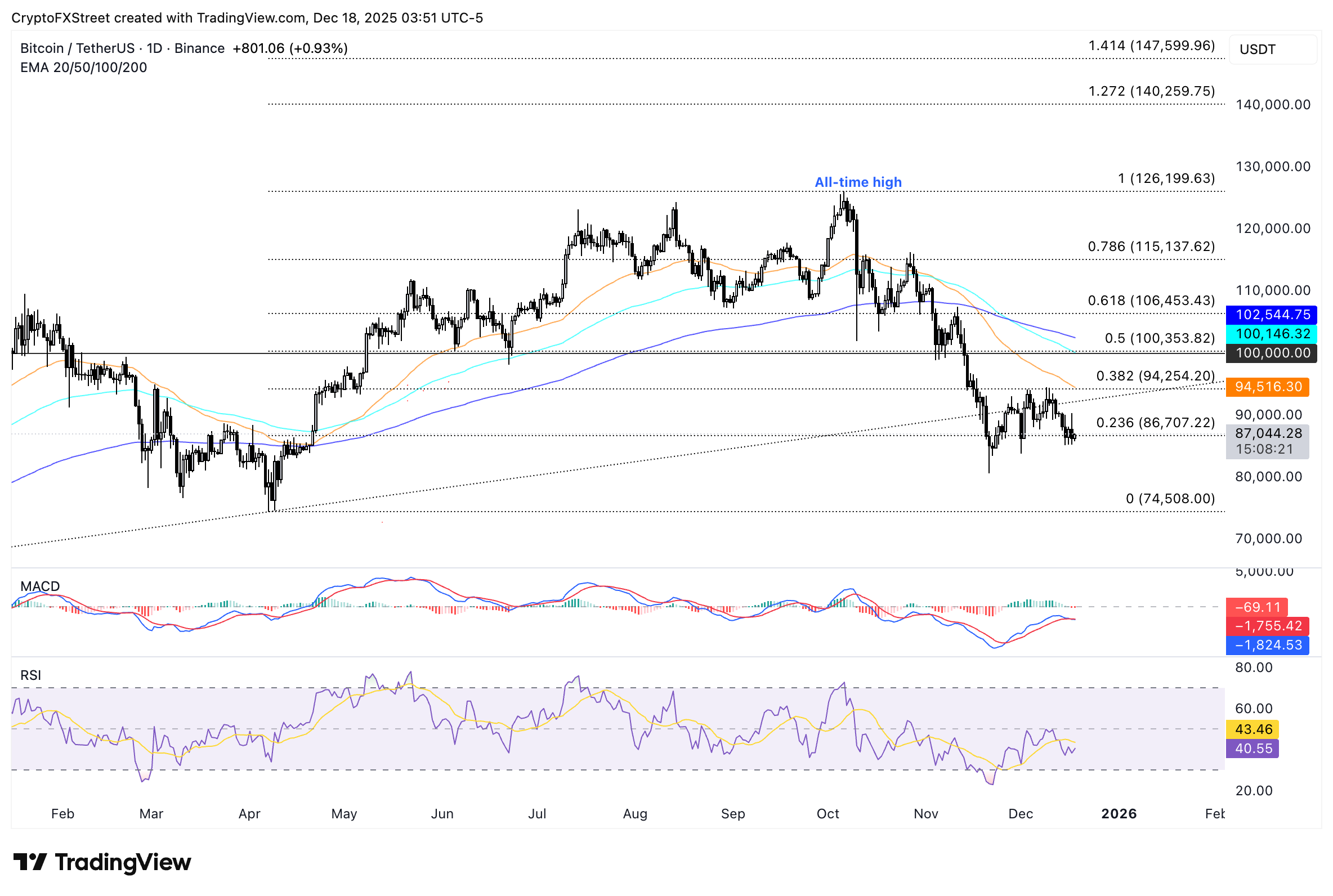
BTC/USDT daily price chart | Source: TradingView
Grayscale analysts told investors in a note that Bitcoin could hit a new record high in 2026. Find out more about this here:
AI sector market cap could hit $30 billion
The Artificial Intelligence (AI) sector gained $5 billion in market capitalization this year, and if the ecosystem continues to grow at a similar pace, it could generate another $5 billion in 2026. The modest prediction stems from the criticism that the AI category faces for being ‘hyped’ and being a bubble.
Bitcoin faced similar critique in the early years, during the bull run in 2017. If the AI sector follows the model, it could see a gain in its market cap, adoption and see an increase in relevance in 2026.

AI sector market capitalization | Source: CoinGecko
The top catalysts that could drive the gain are AI giants like NVIDIA and OpenAI’s launches, as well as the further development of AI applications in the web3 ecosystem. This could potentially drive gains in the AI Agents and AI Applications category.
Stablecoin adoption could fuel beta plays
Visa’s stablecoin pilot and Ripple’s multichain stablecoin made headlines earlier this month. In many ways, 2025 was the year of advancement in stablecoin regulation and adoption. While traders ask what’s next for their portfolios as stablecoins advance, they should focus on leveraged beta plays, such as lending and staking tokens, which could benefit from higher demand coming from newcomers and beginners across crypto exchanges.
Stablecoins are the typical fiat on and off-ramp for traders who are new to crypto, and their rising adoption could fuel these beta plays.
This makes staking and lending tokens like Pendle (PENDLE), Lido DAO (LDO), and Ethena (ENA) relevant for new traders in 2026.
Solana TVL set to rise
Going into 2026, Solana could have the big moment that SOL holders have been waiting for all year. XRP recently announced its plan to launch on the SOL chain, and key announcements from the Breakpoint conference, like FXTech, MediaTek and Trustonic’s plan to integrate the Solana Mobile stack at the Android device chipset level, are likely the big catalysts for Solana next year.
MediaTek accounts for 50% of the global Android market, and Solana is set to gain from higher adoption and demand.
The Total Value Locked (TVL) is $8.51 billion, close to the number at the beginning of 2025. According to the announcements, this number could grow, potentially testing the 2025 peak of $13 billion and beyond.

Solana TVL | Source: DeFiLlama
Regulatory clarity could increase the footprint of retail traders
When describing the ongoing market cycle, regulatory clarity emerges as a key theme. The US ecosystem witnessed the passage of the GENIUS Act, that brought clarity to stablecoins. In several Asian countries, like India in particular, taxation of cryptocurrencies gained clarity. With similar strides worldwide, cryptocurrencies are embracing higher regulatory clarity and intervention for a wider reach.
Retail traders typically gain access to crypto markets through stablecoins, while institutional players have the choice to pour capital into investment vehicles like ETFs, leaving retail demand reliant on fiat on/off ramps.
With a higher focus on regulating crypto in the US, 2026 could see this as a key theme throughout the year.
Privacy all the way
It may be contradictory to think of privacy coins making a comeback in 2026, given that 2025 was the year when Tornado Cash and privacy platforms suffered setbacks. But the recent price trend in ZCash tells a different story.
Trade volume in ZEC has climbed nearly 50% in the last 24 hours. This token has trended for nearly a week now.
After months of influencers and crypto leaders like Arthur Hayes and Ansem advocating the benefits of privacy, the category has made a comeback, and Zcash, a privacy-first token, is gaining traction on social media platforms like X.
Traditional financial institutions to combine offerings with DeFi
Traditional financial institutions started warming up to stablecoins and Bitcoin holdings as well. The growing interest is not new at all. The issuance of crypto-based Exchange Traded Funds (ETFs) by traditional financial institutions like Franklin Templeton has changed the way crypto is blended alongside other assets in portfolios.
The latest wave of altcoin ETF approvals by the US Securities and Exchange Commission (SEC) could support this theme in 2026.
According to analysts, the race for altcoin approvals is far from over, and pending files could see another wave of green lights from the SEC in Q1 2026.
Outlook for fiat turns more uncertain
Rising debt, inflation for long time periods and the risk of credit default in several countries worldwide have fueled uncertainty in traders. Gold’s rising price and Bitcoin’s narrative of ‘digital gold’ are fast gaining traction.
This has, in turn, made traders wary of holding fiat currencies and highlighted the erosion of portfolio value as the currency gets devalued. Such risks could make Bitcoin and stablecoins lucrative for traders and support the bullish narrative.
Tokenization could make big moves, attract more capital
Tokenization of real-world assets (RWAs) has been a recurring theme in most industries in 2025. This facilitated the fractional ownership of assets, easy transfer and faster access, making tokenization a trending issue.
In 2026, tokenization could take center stage as capital flows into BlackRock’s tokenization initiative and several private players enter the space.
The four-year cycle to die in 2026?
The four-year market cycle is a concept in which Bitcoin’s price rallies to a new all-time high at least once every four years. However, this relies heavily on the idea that Bitcoin supply shrinks as mining difficulty increases post a halving event and demand remains consistent.
In the past few cycles, the narrative has shifted, and the ongoing bull run was kicked off in 2024, alongside spot Bitcoin ETFs approval in the US. This started a few months before the halving, atypical of a four-year cycle, meaning it is possible that the narrative may no longer hold in 2026.
Bài viết đề xuất


