

Aster builds recovery momentum as network debuts stage 5 token buyback program
- Aster extends its recovery above $0.70 sentiment improves across the cryptocurrency market on Monday.
- Aster has implemented the fifth stage of its buyback program, aimed at improving tokenomics to create sustainable value.
- Aster has committed to allocating 80% of the protocol’s daily fees toward the buyback program.
Aster is trading above $0.70 at the time of writing on Monday, as the cryptocurrency market extends its recovery albeit gradually. The perpetual decentralized exchange (DEX) native token has increased by over 9% since its record low of $0.65 on Friday, signaling a developing bullish outlook.
Still, investors should temper their bullish expectations, considering a major supply zone has formed between $0.74 and $0.75.
Aster extends token buyback program
Aster has announced the launch of its fifth token buyback program. The program aims to establish structured support for ASTER by strengthening the protocol’s tokenomics to create sustainable value for the community.
The network will, from Tuesday this week, allocate 80% of daily platform fees toward ASTER buybacks. According to a post on X, the program is divided into two phases: A 40% automatic daily buyback to provide consistent on-chain support and gradually reduce supply.
The second phase of the program is a “Strategic Buyback Reserve” ranging from 20% to 40%, which will be executed based on market conditions.
“This reserve gives us the flexibility to respond to volatility and maximize value creation when opportunities arise,” Aster stated.
A token buyback is a mechanism used by crypto projects to reduce the circulation supply of a token. The process works by reducing the potential selling pressure, thereby helping to create sustainable value for the community and the ecosystem. The effect of token buybacks on the price is not immediate but observed over an extended period of steady executions.
Technical outlook: Can Aster hold support ahead of a potential breakout?
Aster price is trading above $0.70 at the time of writing on Monday. The token’s short-term outlook remains somewhat neutral to bullish, as reflected by the Relative Strength Index (RSI) at 46 on the 4-hour chart. To confirm a strong bullish thesis, the RSI should rise above the 50 midline.
The Moving Average Convergence Divergence (MACD) indicator maintains a buy signal triggered on Friday on the same chart. As the green histogram bars above the mean line expand, they could prompt investors to increase exposure, pushing Aster toward the 50 Exponential Moving Average (EMA) at $0.76.
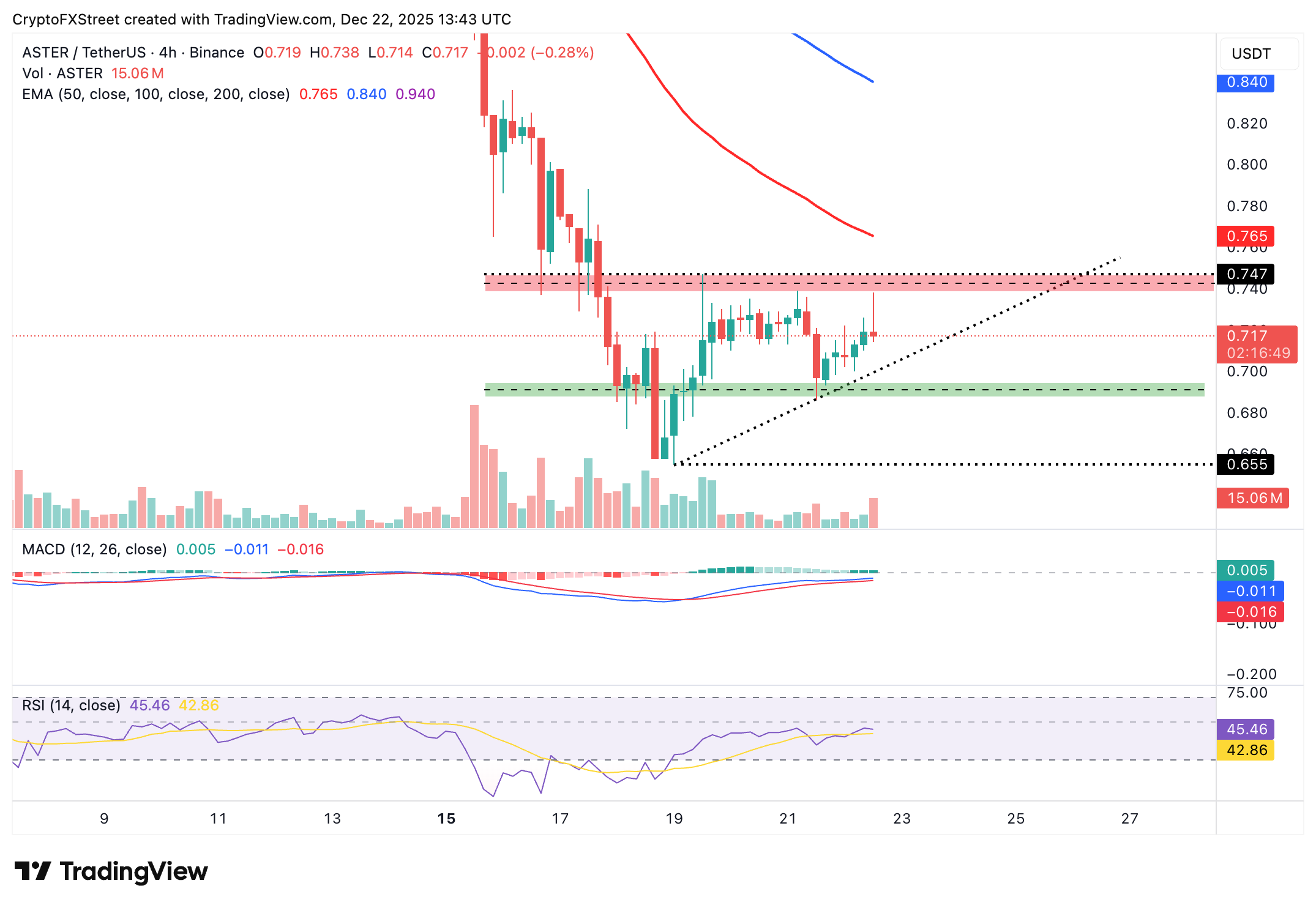
Still, the MACD indicator remains in the bearish region, suggesting that Aster is not out of the woods yet and that downside risks could push the price below $0.70. Key areas of interest for traders are the demand zone at $0.68 and Aster’s record low of $0.65.
Cryptocurrency prices FAQs
Token launches influence demand and adoption among market participants. Listings on crypto exchanges deepen the liquidity for an asset and add new participants to an asset’s network. This is typically bullish for a digital asset.
A hack is an event in which an attacker captures a large volume of the asset from a DeFi bridge or hot wallet of an exchange or any other crypto platform via exploits, bugs or other methods. The exploiter then transfers these tokens out of the exchange platforms to ultimately sell or swap the assets for other cryptocurrencies or stablecoins. Such events often involve an en masse panic triggering a sell-off in the affected assets.
Macroeconomic events like the US Federal Reserve’s decision on interest rates influence crypto assets mainly through the direct impact they have on the US Dollar. An increase in interest rate typically negatively influences Bitcoin and altcoin prices, and vice versa. If the US Dollar index declines, risk assets and associated leverage for trading gets cheaper, in turn driving crypto prices higher.
Halvings are typically considered bullish events as they slash the block reward in half for miners, constricting the supply of the asset. At consistent demand if the supply reduces, the asset’s price climbs.
Bài viết đề xuất


